
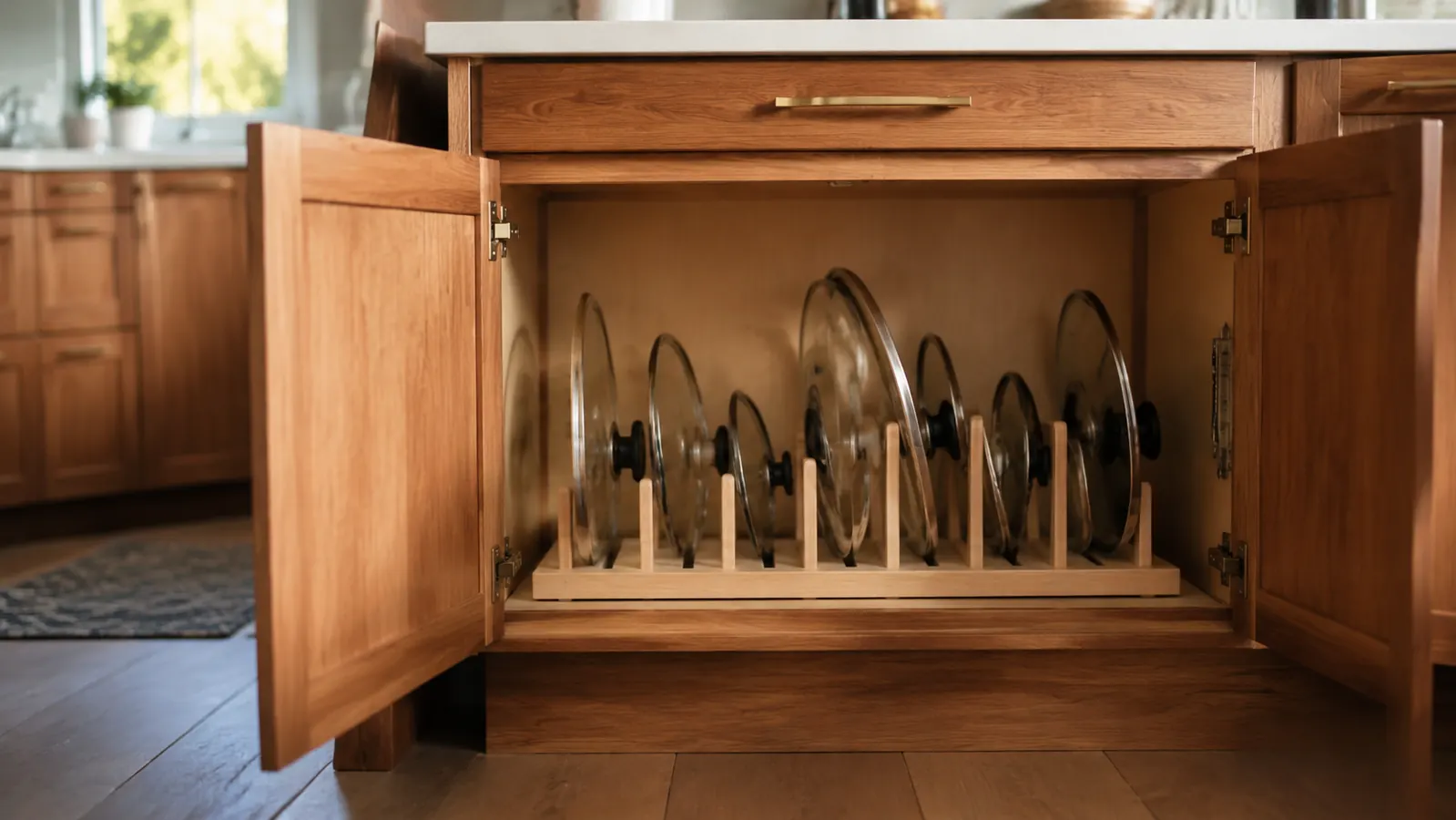
The cabinet to the left of my stove used to make a specific sound. Not a clank, more of a landslide, six or seven lids sliding sideways the second I pulled out the stockpot lid from the bottom of the pile. My husband Greg started calling it "the avalanche cabinet" and he was not wrong. Every dinner prep meant crouching down, easing the door open like I was defusing something, and usually still ending up with a lid rolling across the floor toward the dog's water bowl.
I fixed it in about forty five minutes on a Sunday afternoon with a Housolution expandable pot lid organizer, a tape measure, and every lid I own laid out on the counter like a strange metal fan. No drill, no shelf liner, no trip to a specialty container store. If your cabinet sounds like mine did, here is exactly how I measured the space, sized the rack, and sorted the lids so the whole thing actually stays put.
Before the steps, here is the rack that ended the avalanche cabinet at our house.
The Housolution 2 Pack Expandable Pot Lid Organizer slides from 12 to 23 inches to fit almost any lower cabinet, holds lids upright in individual slots, and has more than 6,300 reviews at a 4.5-star rating on Amazon. It is the exact rack I used behind our stove.
Amazon Check Today's Price on Amazon →Step 1: Measure the Cabinet Before You Buy Anything
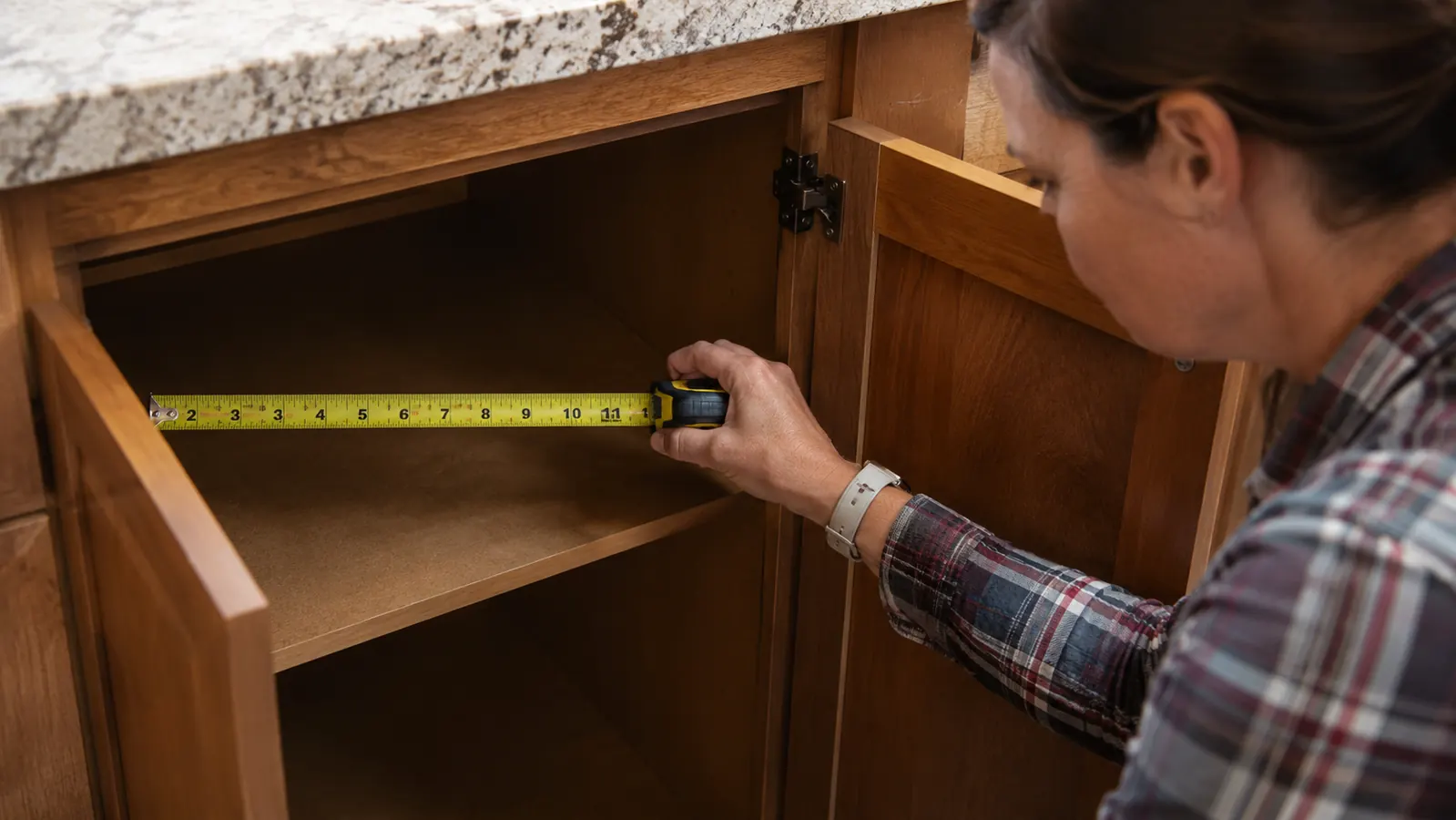
Empty the cabinet completely first. Pull every lid, every stray baking sheet, everything out onto the counter so you can see the bare inside walls. I know it is tempting to eyeball it, I did that with a different organizer years ago and ended up returning it twice because it did not fit. Take a real tape measure and get the inside width, wall to wall, at the point where the rack will actually sit, which for most lower cabinets is the floor of the cabinet, not the opening.
Our cabinet measured nineteen inches inside, which mattered because the Housolution rack expands from twelve inches up to twenty three, so I had five inches of adjustment room on either side of where I needed to land. Write your number down. If your cabinet runs narrower than twelve inches or wider than twenty three, this particular rack will not work and you will want to measure for a smaller fixed rack instead, but most standard lower cabinets fall inside that range.
While you have the tape measure out, also check the height from the cabinet floor to the shelf above it, if there is one. Lids standing upright need clearance, and our tallest stockpot lid stands about five and a half inches. I measured up to the bottom of the shelf above and confirmed I had almost seven inches of clearance before I committed to anything. A rack that is the right width but gets blocked by a shelf six inches up is a rack you will be returning.
Step 2: Sort Every Lid by Size Before You Load the Rack
This is the step that made the biggest difference for me, and it is the one I almost skipped. Lay every lid you own flat on the counter and arrange them from largest to smallest, left to right. I had nine lids total, a stockpot lid, a Dutch oven lid, two skillet lids, three saucepan lids in descending sizes, a small butter warmer lid, and one glass lid that belonged to a casserole dish I use on the stovetop for simmering.
Sorting first matters because it is much easier to load a rack in size order than to load it randomly and shuffle lids around afterward while they are already wedged into slots. It also means when you go looking for the small saucepan lid at six o'clock with dinner half made, you already know which end of the rack it lives on instead of scanning the whole row.
If you have any oddly shaped lids, ours included one with a broken knob that I have been meaning to replace for two years, set those aside mentally. They still slot into the rack fine standing on edge, but they may need a slightly wider gap on either side than a standard round lid does, so plan to give that one a little extra breathing room when you load it in Step 4.
Step 3: Expand the Rack to Match Your Cabinet Width
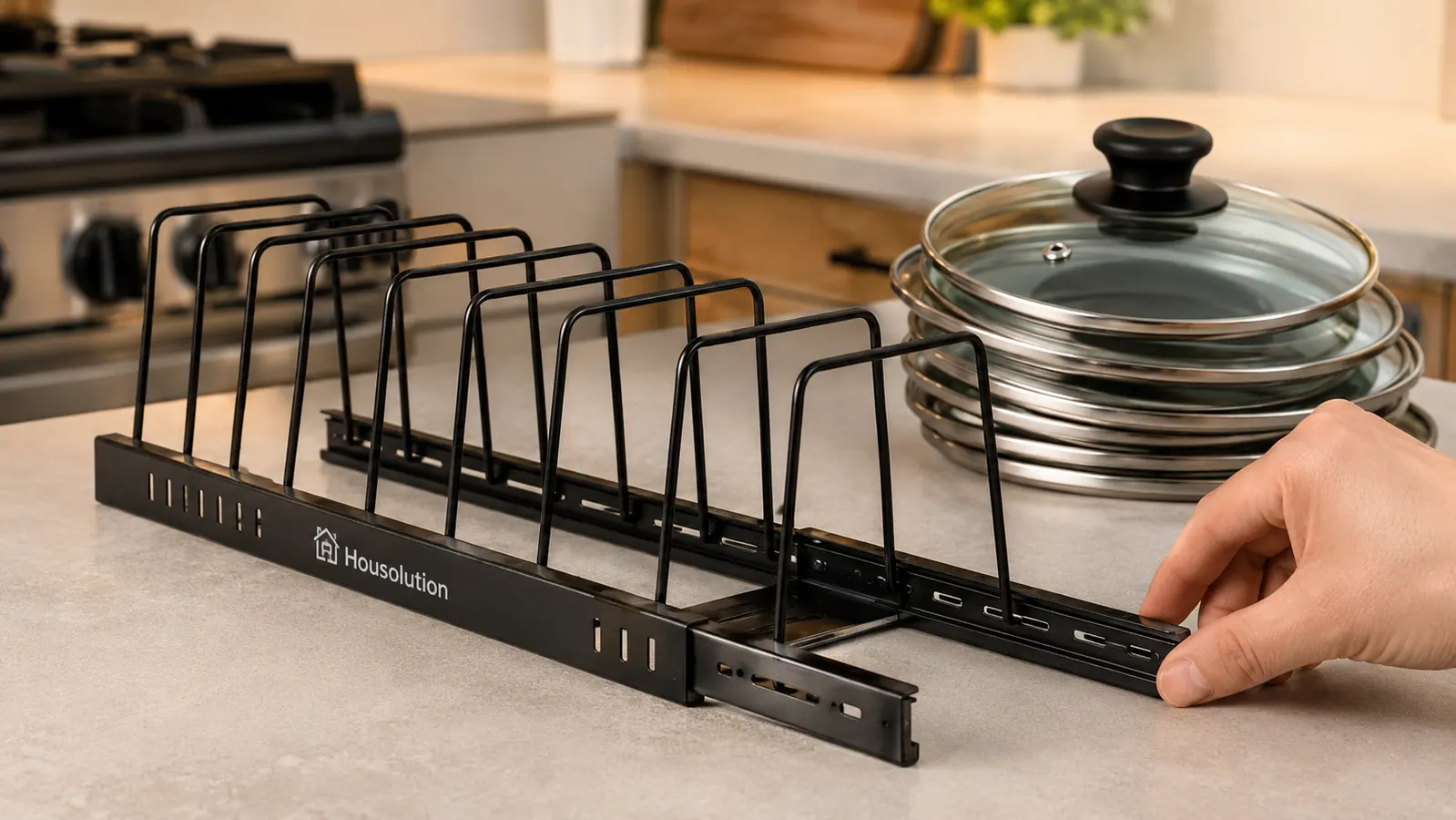
Set the rack on the counter and find the sliding mechanism, usually two rails that telescope out from the center section. Pull it open gradually, checking the width against your tape measure as you go rather than yanking it straight to what you think is the right spot. I extended ours to eighteen and a half inches, giving me a quarter inch of play on each side once it sat inside the nineteen inch cabinet, enough to slide it in and out for cleaning without it feeling loose and wobbly.
Most expandable racks like this one lock into position with a simple screw or clip once you land on the right width, so tighten that down before you start loading lids. If you extend it and load lids first, the added weight makes it harder to adjust the width afterward, and I learned that the annoying way on my first attempt, unloading nine lids to shave off half an inch.
Set the rack inside the cabinet dry, with no lids in it yet, and confirm it sits flat on the cabinet floor without rocking. Ours has small rubber feet on the base that keep it from sliding around when the cabinet door swings open, but if your cabinet floor is uneven or has a lip near the front, you may need to nudge the rack back an inch or two until it settles flush.
Step 4: Load the Lids Largest to Smallest
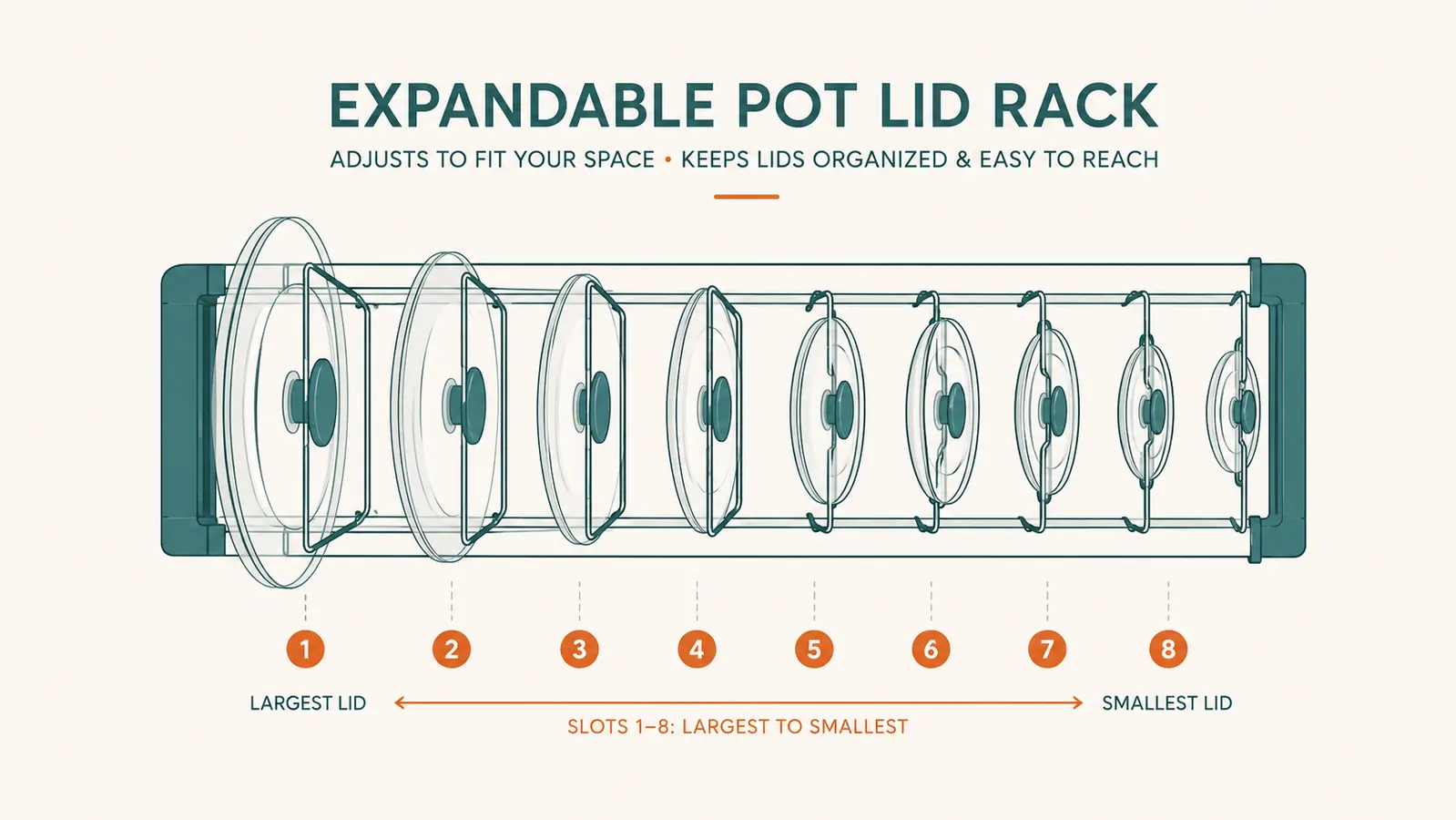
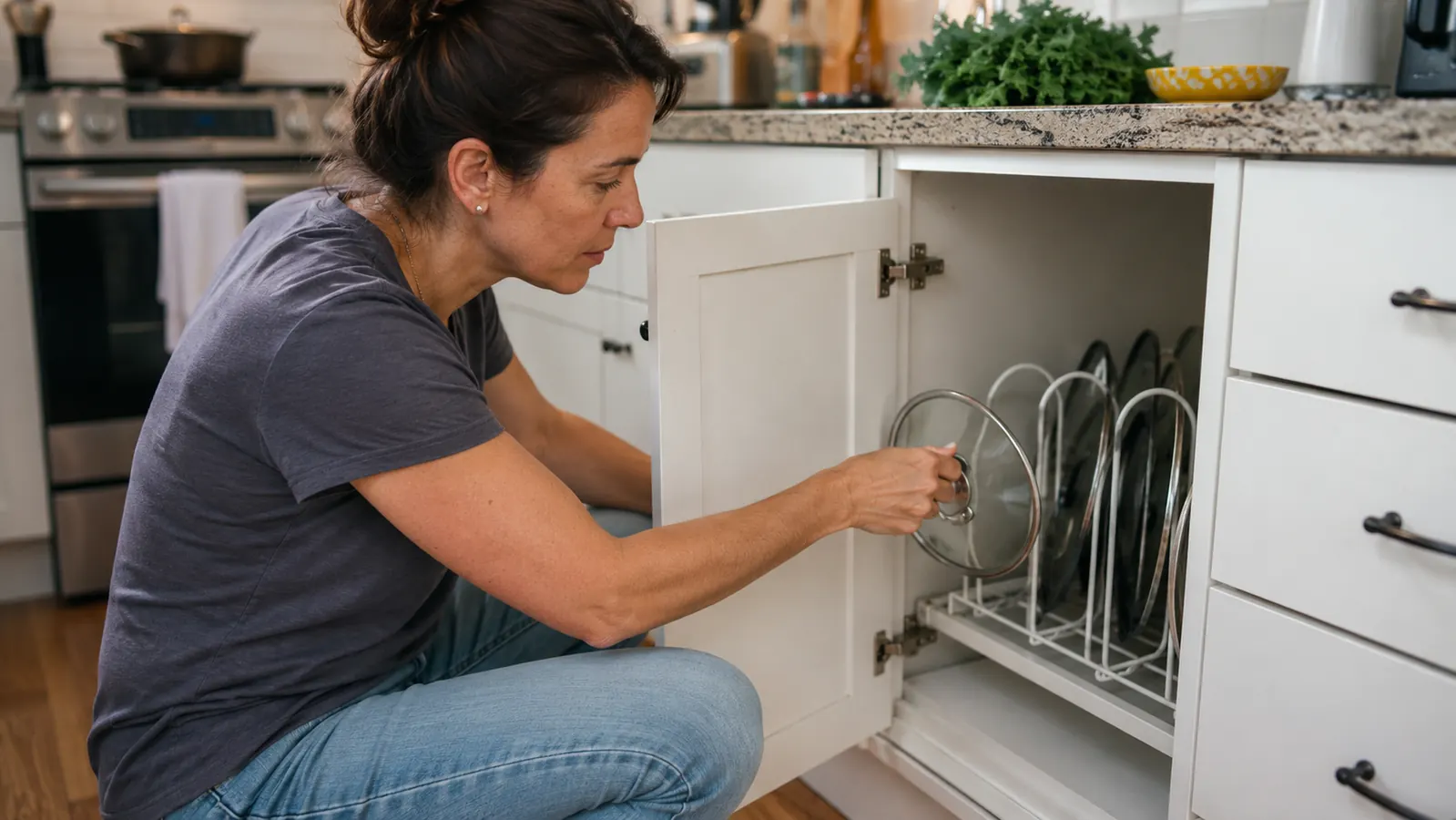
Starting from one end, slide your largest lid into the first slot standing on its edge, handle facing up so you can grab it without fishing around. Work your way across in the size order you sorted back in Step 2. I put the stockpot lid and Dutch oven lid on the left, since those are the two I use least often and do not mind reaching a little further for, and kept the everyday skillet and saucepan lids on the right side closest to the cabinet opening.
Give each lid its own slot rather than doubling up two thin lids in one slot to save space. It is tempting when you are down to the last small lid and short on room, but doubled-up lids are exactly what starts the leaning and sliding you are trying to fix in the first place. If you run out of slots, that is a sign you either need the rack extended a bit wider, within your cabinet's limits, or you genuinely have more lids than one rack comfortably holds, which is common if you have a big collection of saucepans.
For the glass casserole lid, I set it in its own slot near the end rather than sandwiched between two metal lids, mostly out of habit from years of nervous glass handling. It has held up fine in there for the past several months, but if you are precious about a specific glass piece, giving it a slot with a little more breathing room on either side is a cheap insurance policy.
Step 5: Slide the Rack Into Place and Do the Push Test
Once every lid is loaded, slide the whole rack into the cabinet and push it back until it sits flush against the back wall or wherever it naturally stops. Close the cabinet door slowly the first time and listen. If you hear anything shifting or clanking, open it back up and check whether one lid worked loose from its slot during the slide in, usually the culprit is a lid that was not seated fully upright before you moved the rack.
Then do what I call the push test. Reach in and pull the lid you use most often straight out, the way you actually would mid-dinner-prep, then slide it back in. Repeat with two or three others. You are checking that no lid drags its neighbor sideways when it moves, which is the whole problem an expandable rack is supposed to solve. If everything slides cleanly with the rest staying put, you are done. If one lid keeps catching, it may just need to be reseated a little further back in its slot.
Close the door and open it a few more times over the next day just going about normal cooking, not as a deliberate test but just living life. That is honestly the real test. Our cabinet went from the loudest one in the kitchen to the quietest, and it has stayed that way through I don't know how many dinners since.
Greg opened that cabinet about a week later looking for the Dutch oven lid, grabbed it, and closed the door without a single thing shifting. He didn't say anything. He just didn't have to say anything, which honestly told me more than a compliment would have.
What Else Helps
If your lids are the main mess but your pots and pans underneath them are still stacked and clattering, a second rack sized for your pans, or a set of adjustable pan dividers, tackles that half of the cabinet the same way. I did our pots the following weekend with a second rack and honestly wish I had just bought both the day I fixed the lids, would have saved me an extra trip.
For lids that do not stand well on their own, thin flat lids with no real lip along the edge, a slight forward tilt in the slot usually solves it. Most expandable racks like ours have a mild angled base built in for exactly this reason, so before you assume a lid does not fit, try seating it a little further forward or back in the slot before giving up on it.
If you ever add a new pot to the collection, birthday gift, upgrade, whatever brings it home, resist the urge to just balance the new lid on top of the rack instead of finding it a real slot. Pull the rack out, resort if needed, and give it a proper spot. It takes two minutes and keeps the whole system working the way it did the day you built it, which for us has now been well over half a year without a single avalanche.
Tired of the lid avalanche every time you reach for the stockpot? This is the rack that fixed it for us.
The Housolution 2 Pack Expandable Pot Lid Organizer adjusts from 12 to 23 inches to fit most lower cabinets, holds each lid upright in its own slot, and carries a 4.5-star rating across more than 6,300 Amazon reviews. It ended our cabinet's avalanche problem in one afternoon.
Amazon Check Today's Price on Amazon →