
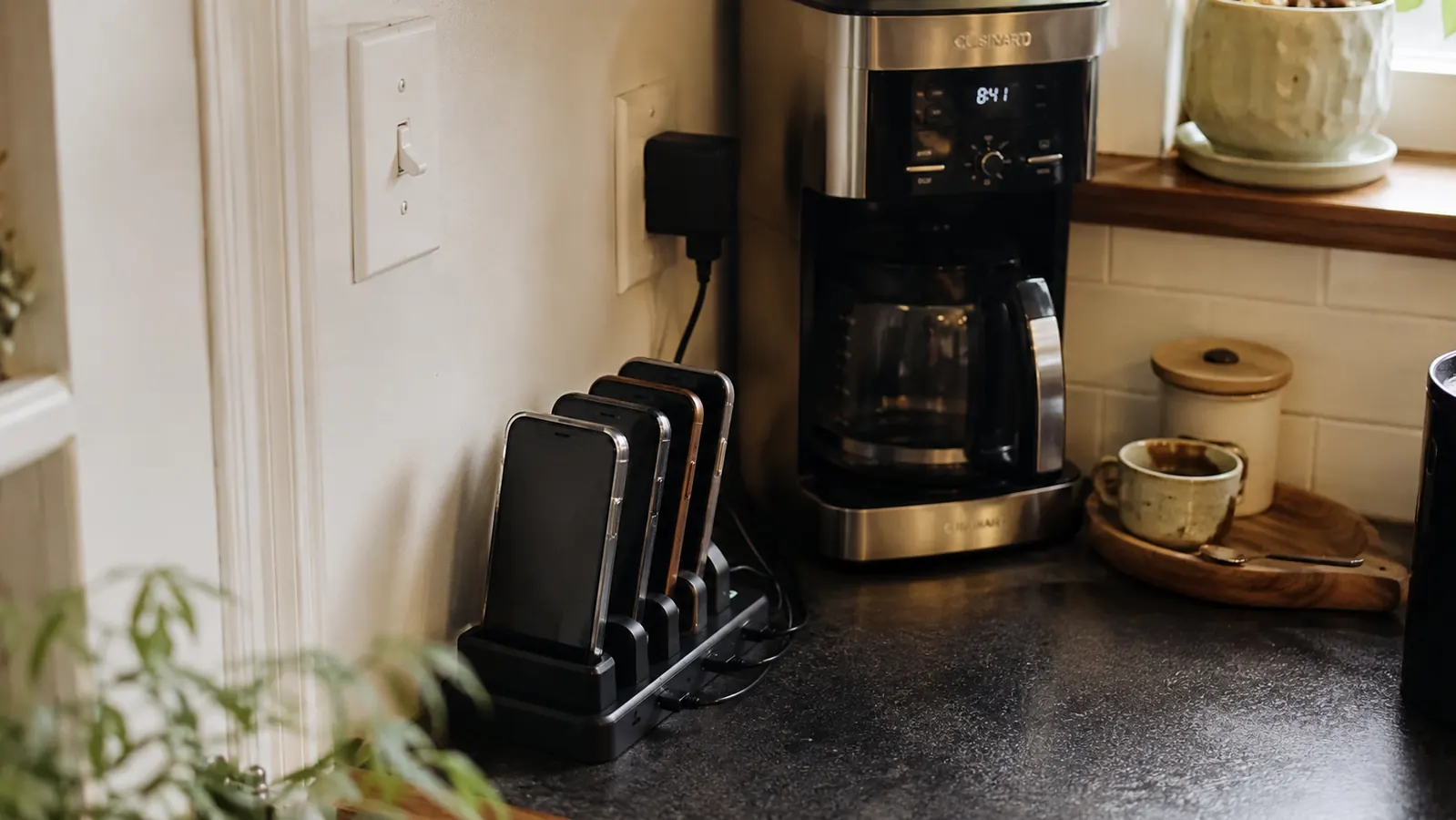
Our kitchen counter used to have a permanent pile next to the coffee maker. Four phone chargers, a tangled iPad cord, and a power strip with so many things plugged into it that I was half convinced it was going to trip the breaker every night around nine. I bought the Hercules Tuff charging station in January, mostly because I was tired of my son Jake asking where his charger went for the third time in a week when it was, in fact, buried under a stack of mail the whole time.
This isn't a review written the week it showed up. I've had this thing plugged into that same outlet since the second week of January, surviving my husband Dave's work phone, my daughter Emma's phone, Jake's phone, my own phone, and an iPad that rotates between all three kids depending on who's begging hardest that day. Six months later, I know exactly which parts of the marketing held up and which ones didn't.
I almost didn't buy it. I'd already bought two cheaper charging stands off Amazon that year, one that tipped over if you looked at it wrong and one where the ports stopped charging entirely after about six weeks. So I went into this purchase expecting to be disappointed a third time, which is honestly the only reason I paid close enough attention to notice both the good and the annoying parts as they showed up over the following months.
The Quick Verdict
It ended the charger-hunting chaos for good, but two of the six ports charge noticeably slower and the cords that come with it are shorter than you'd think.
Amazon Check Today's Price →Tired of asking who took the good charger this time?
This little dock swallowed four phones and an iPad and put an end to the nightly scavenger hunt. Six months later, it's still sitting on my counter doing exactly that.
Amazon Check Today's Price on Amazon →How I've Used It on Our Kitchen Counter
Our setup is a small corner of counter next to the coffee maker, the one spot with an outlet that doesn't already have a toaster or a blender parked on it. Before the Hercules Tuff dock, that corner was a rotating pile of loose cords, a couple of wall bricks, and whatever phone case had been peeled off and abandoned nearby. Dave used to joke that our kitchen had a charging graveyard, and honestly, that was generous.
I set the Hercules Tuff station up on a Sunday night while the kids were finishing homework. It comes with its own cords, six of them, a mix of Lightning, USB-C, and micro USB tips that snap onto the ends, so I didn't have to dig through a drawer to find enough chargers to fill every slot. I plugged it into the wall, ran each cord through the little back channel to keep them from flopping around, and stood four phones and one iPad up in the slots. The whole thing took about fifteen minutes, most of which was me untangling the cords that were still zip-tied together in the box.
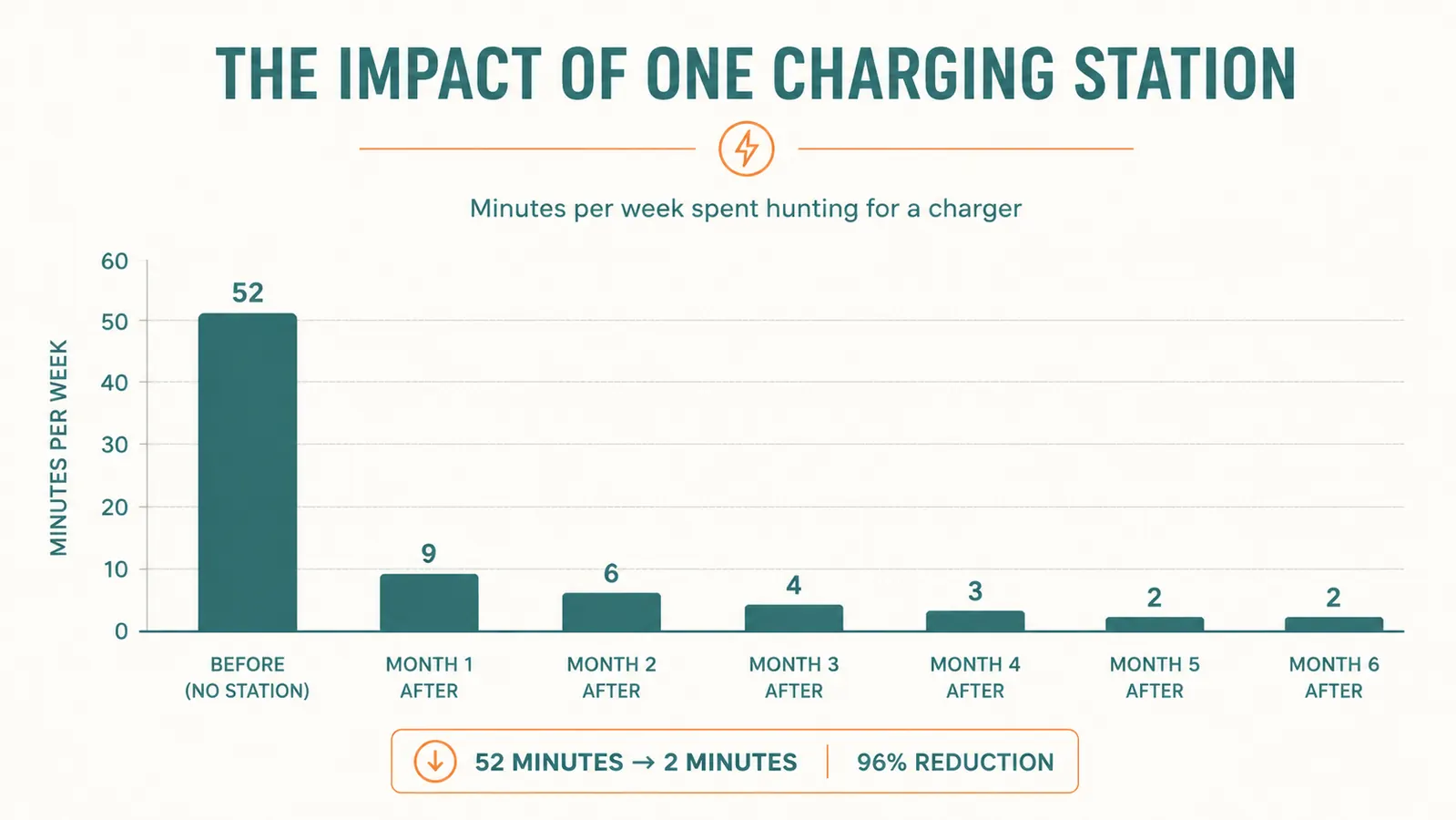
I didn't do anything creative with it. No labeling the slots, no color-coding cords by kid. I just wanted every device to have one designated spot, and I wanted to be able to grab my own phone off the counter in the morning without patting down three other chargers first to figure out which one was mine. That part alone changed our mornings more than I expected.
The habit stuck faster than I thought it would. Within about a week, the kids started walking their phones straight to the counter at bedtime without being told, mostly because it was easier than hunting for a charger in their own rooms. Emma still forgets sometimes, usually on nights she falls asleep doing homework at the kitchen table, but even then her phone is only a few feet from where she left it, not lost somewhere in a backpack.
What's Actually in the Box
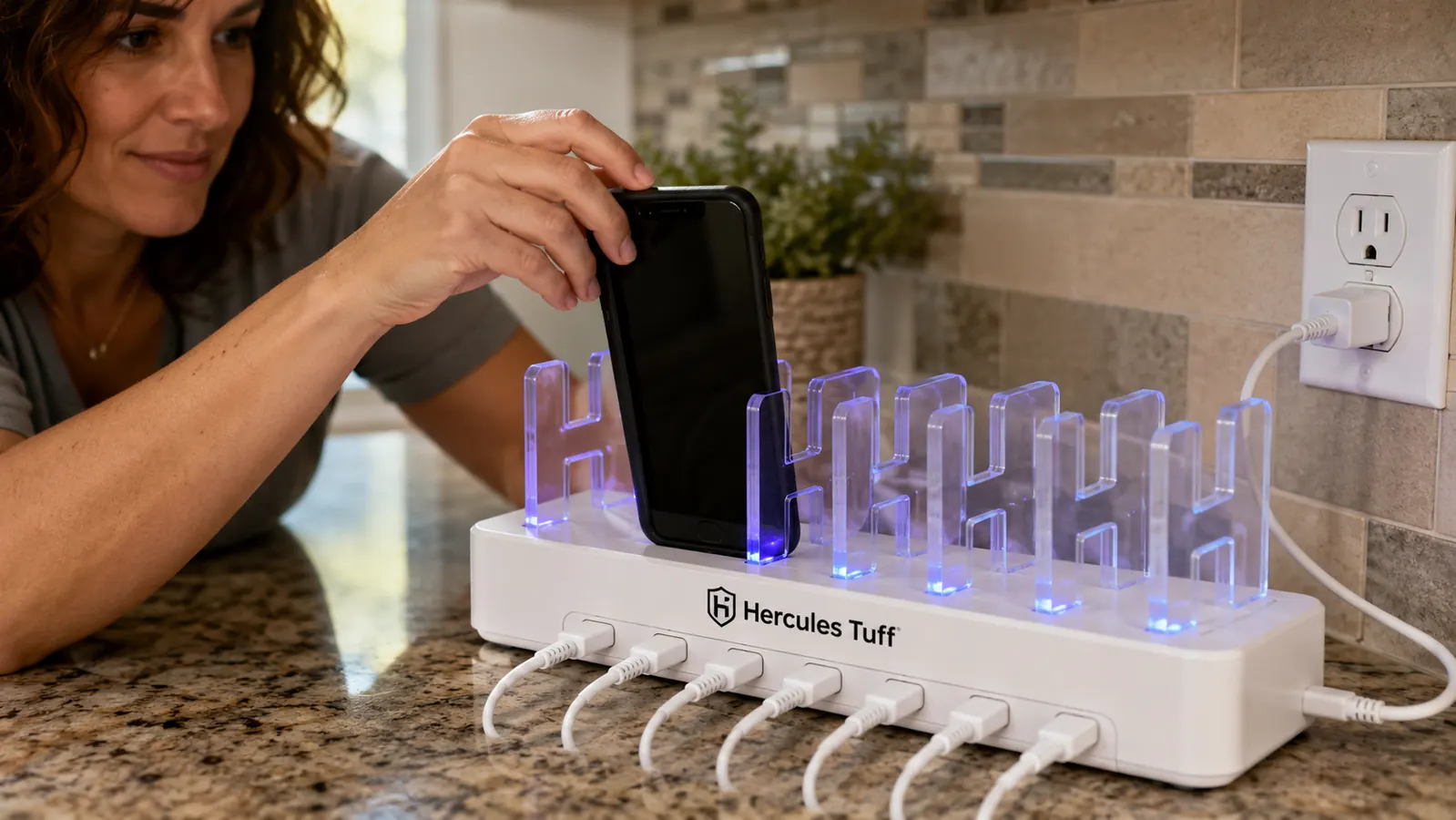
The dock itself is a molded plastic stand with six angled slots, each one holding a phone upright at a slight lean so you can still see the screen light up when a notification comes in. It's white, about the size of a small toaster footprint, and it doesn't look out of place sitting next to our coffee maker the way I worried a bulky charging tower might. The plastic feels sturdy, not flimsy, though it is plastic, so I wouldn't call it heavy-duty in the way a metal stand would be.
The six included cords are removable, which I liked, because when Jake's charging tip finally frayed at the connector after about four months of him yanking his phone out too fast, I just swapped in a spare cord instead of needing a whole new dock. The port block on the back has a small on-off switch too, which is a nice touch if you want to kill power to the whole unit overnight instead of leaving six things trickle-charging while everyone sleeps.
One thing I noticed early and confirmed later with an actual stopwatch is that not all six ports charge at the same speed. Two of the ports, the ones nearest the power switch, charge a phone from dead to full noticeably faster than the two on the far end. It's not a dealbreaker, but if you've got a kid who needs a fast top-off before school, you learn pretty quickly which slots to fight over.
Six Months In: Does It Still Hold Up
This is the part most reviews skip, because most get written the week the box arrives. Mine is written in July, after this dock has survived a spilled glass of orange juice, roughly a hundred and eighty mornings of four kids and adults grabbing phones at once, and Jake dropping his phone directly into its slot from about a foot up more times than I want to admit.
The plastic housing hasn't cracked or yellowed, even sitting under our kitchen's overhead lights for six months straight. The slots still hold phones upright without wobbling, which surprised me, because our old wall-charger setup used to have cords so worn they'd barely stay plugged in by month three. This one still feels the same as the day I set it up, minus one small crack near the base of Jake's old slot from the orange juice incident, which is more on him than the dock.
The cords are where it shows wear first. Two of the six original cords are starting to fray slightly near the connector, the kind of thing you notice when you're coiling them up at night and feel a little give in the rubber that wasn't there in January. I've already replaced one with a spare I had lying around. If you've got kids who yank cords out by the cable instead of the plug, budget for replacing a cord or two before the dock itself gives you any trouble.
The Charging Speed Question
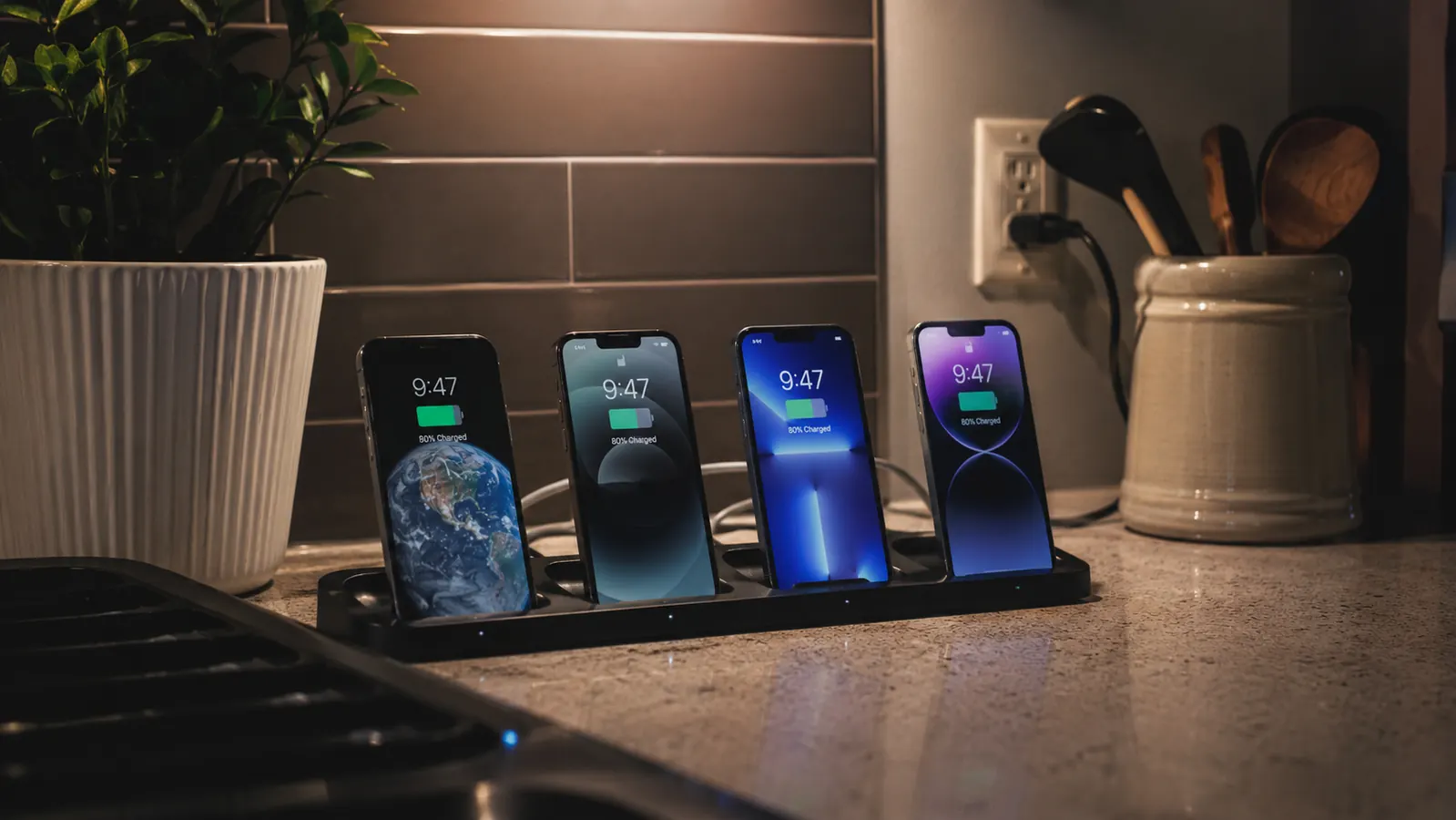
I mentioned the uneven port speeds above, but it's worth digging into because it's the one thing that would have changed how I set expectations if I'd known going in. The two fastest ports charge a fully dead iPhone to around eighty percent in a little under two hours, which is fine, not fast-charger fast, but perfectly livable for an overnight charge. The two slowest ports take closer to three hours for the same job, which matters if someone's phone died at eleven at night and they need it charged before a seven a.m. alarm.
None of the six ports are true fast-charging ports in the way a modern wall brick is, so if you're used to plugging your phone into a 20-watt charger and watching the percentage climb in real time, this will feel slower across the board. For our family, where phones mostly charge overnight or during dinner, the speed has never actually been a problem. It only bit us the handful of times someone forgot to plug in until right before bed.
Other Options I Considered First
Before this, I looked at just buying a bigger power strip with more USB ports built in, the kind that sits flat on the counter. That would have been cheaper, but it still leaves phones lying flat, which meant they'd get buried under mail and dish towels within a week, which was exactly the problem I was trying to fix. I also looked at wall-mounted charging shelves that screw into a cabinet, which look great in photos, but we rent, and I wasn't drilling holes into cabinetry for a charging dock.
I also considered just buying everyone their own wall charger and calling it a day, which is honestly what we'd been doing for years. The problem was never having enough chargers, it was that four separate cords scattered around the house meant someone always had the wrong one at the wrong time. The dock solved that by giving every device one home, in one spot, that everyone in the house already knows to check first.
I briefly looked at a fancier wireless charging tower too, the kind that charges a phone, a watch, and earbuds all at once with no cords at all. It looked great in the photos, but it only handles one phone at a time, and with four people needing a spot every night, that was never going to work for us. A dock with six physical slots solved the actual problem, which was volume, not tidiness for tidiness's sake.
Was It Worth It
I checked today's price again while writing this, and it's still one of the cheaper fixes I've bought for this house, especially compared to what I would have spent replacing lost or broken individual wall chargers over the same six months. We used to go through a charger every couple of months, usually because one got left in a backpack or ran over by a car in the driveway. That alone almost paid for this.
More than the money, it's the mornings that changed. Nobody is late for the bus because they can't find a charger anymore. Nobody is digging through the junk drawer at eleven at night. It's a small fix, but it's the kind that quietly saves you a little friction every single day, and after six months of that, I'd buy it again without thinking twice.
What I Liked
- Fits six devices at once, ends the daily charger scavenger hunt
- Included cords cover Lightning, USB-C, and micro USB out of the box
- Plastic housing hasn't cracked or yellowed after six months of daily use
- Cords are individually replaceable if one frays
- Small footprint, fits in a tight kitchen counter corner
- On-off switch lets you kill power to all six ports at once
Where It Falls Short
- Two of the six ports charge noticeably slower than the other four
- Included cords are on the shorter side and start showing wear by month five or six
- No true fast-charging port for anyone who needs a quick top-off
- Plastic slots can crack if a device is dropped into them hard enough
Six months in, the thing I notice most isn't the dock itself. It's that nobody in this house asks where their charger went anymore.
Who This Is For
If you've got more than two people in the house sharing one outlet and a pile of tangled cords, this is a genuinely easy fix. It's especially good for families where everyone's phone ends up in the same charging spot anyway, or for anyone who's tired of buying replacement wall chargers because the old ones keep growing legs. It's also a solid pick if you want a charging station and iPad slot without giving up your only kitchen outlet to a power strip.
It's worth it too if you're the type who likes one designated landing spot for devices at the end of the day, since it makes the nightly routine of collecting phones and putting them on the charger a lot faster for everyone in the house.
Who Should Skip It
If you or your family need consistent fast charging on every single device, like someone who's constantly running low mid-day and needs a quick top-off before heading back out the door, the two slower ports will be a real annoyance. And if you've got more than six devices in rotation, you'll be shuffling phones in and out of slots the same way we used to shuffle wall chargers, just with fewer cords tangled up along the way.
Ready to stop hunting for chargers every night?
Six months of daily family use later, this is still the simplest fix I've found for our charger chaos. Check today's price and see current availability before you buy.
Amazon Check Today's Price on Amazon →